Don't be fooled by the title, being single, I still have no kids, ladies, anyone?!
Yeah, right... that's the platform for this...
Back to business, i.e.
photography.
After a relatively short, wait, which felt like an eternity of course, the
Pinwide by wanderlustcameras.com fell through my "brievenbus" (in Holland that is a slot in your front-door, not a box outside the house, very convenient in bad weather!).
Right, back to the Pinwide. Some would call it a "lens", but it is not. Some would call it a "photographic objective", which it eventually is. The Pinwide just does not use any optical lenses, i.e. bubbles of glass where light is pushed through.
As the name suggests, the Pinwide is just a pinhole, a very very very small hole. That's it!
To be honest, I though the price on "glass" without glass was pretty stiff in the first place. But going old skool should be priceless anyway. Hence, the $US40 for the camera objective plus $US10 shipping just had to be spent. Speaking money, you may ask if it is worth spending this amount for a very small amount of round nothing? Hell yes it is!
Mail came late today, hence, I made my first shots with the Pinwide during dusk.
Never the less, I took a tripod, the Olympus E-PM2 and the Pinwide... and got out! Of course, people came along asking stupid questions... arghhhh, haven't you seen a guy with a camera on a tripod before?!!!!
There are essentially two options to use the pin-hole: 1) on a tripod or 2) with very high ISO.
Here are test with both. Let's start with the second option, high ISO, actually ISO 25600, the highest the E-PM2 can go.
 |
| s/15 @ ISO 25600 scaled to 640x480 |
 |
| s/15 @ ISO 25600, original resolution, cropped |
That look old skool, doesn't it?!
As said before, this is dusk, at s/15 this shot could have been done handheld, hands down, so to speak.
Now, lets look at the other end of the scale, the first option. My Olympus E-PM2 goes down to ISO 200 only. Mind you, the Panasonic LX's lowest ISO is 80!
OK, here it comes, sorry, I changed my position due to people coming up again, nagging about, socializing they call this...
 |
| 15s @ ISO 200 scaled to 640x480 |
 |
| 15s @ ISO 200, original resolution, cropped |
Alright, this is old skool. At the days of pinhole cameras, i.e. camera obscura, color film did not exist. Ups, mistake on my side, to the time of "camera obscura" film did not exist, neither color, nor black&white. We are hence talking about
pinhole cameras. A certain David Brewster took the first photograph ever with such a camera. Yep, old skool! This will be subject to an experiment in the future, stay tuned (in my very own youth, I experimented with making paper light-sensitive by soaking in a saline solution).
Back to modern days possibilities. The images shown above did not receive any treatment. Other than converted from RAW into 100% quality JPG and either scaled or cropped.
Lets look at one that actually was treated, not much though.
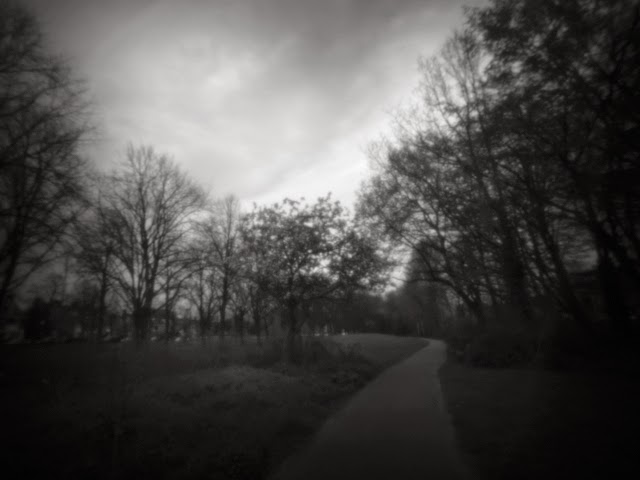 |
| converted to B&W, scaled, brightness and contrast adjusted |
The 15s @ ISO 200 image was converted into black&white using GIMP by means of desaturation based on luminosity.
Physics live! The side effect of the Pinwide... very cool!
As you can see in the color images, diffraction kicks in, so small is the pinhole. You get actually color-vignetting.
In the center of the images, all wavelengths are essentially following the laws of geometric optics.
At the very edges, diffraction kicks in, meaning that light depending on the wavelength gets more around the corners at sharper or shallower angles. From the color distribution of the images one could actually determine the diameter of the pinhole.
For full benefit of a pinhole camera objective, i.e. a very very very deep field of focus w/o any adverse effects, I am looking for a "Pinlong" to be made. Actually, I will contact the guy at wanderlustcameras about that. Such an objective will stay in the region of geometric optics, thereby not introducing all that diffractive delusion.
In that context, a Pinportrait would be quite nice to have too ;-)
Ophthalmology live!
Probably not even the makers of the Pinwide have thought about this. If you hold the Pinwide to either one of your eyes, no camera attached of course, and pointing it towards a homogenous source of illumination, preferably placing the object side of the Pinwide towards your eye(s), you will actually see shadows of the interior parts, such as veins, of your very own eye(s)! How cool is that?!
Why does this happen? Because the light entering your eye is extremely hard, in photography terms.
Again the question, was the Pinwide worth the money? Ohhh yesss! Every single penny!


